

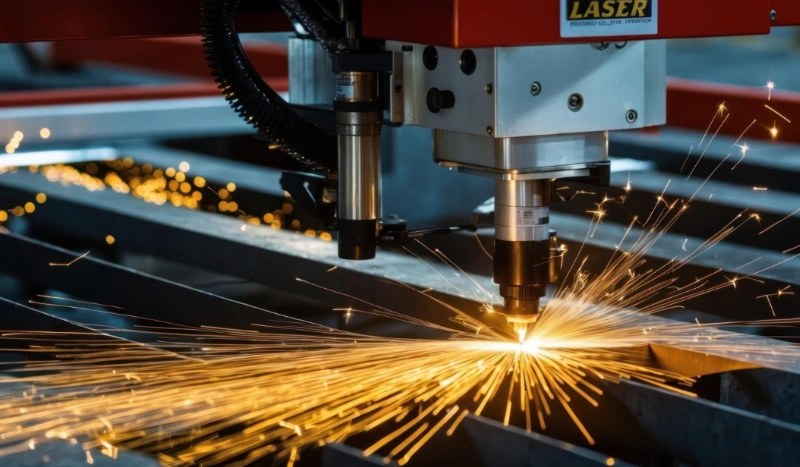
Choosing the right type of metal cutting is very important not only for metal fabricators but also for industrial manufacturers. The type of machine you choose will determine your productivity levels, costs, and profits.
Plasma cutting vs laser cutting can be considered one of the most crucial decisions in the manufacture of metal products. Although both processes provide effective cutting due to high efficiency in heat application, they have different mechanisms and are suitable for different material thicknesses.
What Is Plasma Cutting?
Plasma cutting is a method of thermal cutting in which an electrically conductive gas is used as the energy source in the plasma torch. Air, nitrogen, and oxygen may be used in the process and they will come out from a tiny opening at an incredibly high speed. The arc will ionize the gas and result in the formation of plasma jets at temperatures greater than 20,000°C.
Material Suitability & Applications
- Compatible Materials: Mild steel, stainless steel, aluminum, brass, copper, and other electrically conductive metals.
- Thickness Range: Very effective in medium to thick plate thickness (6 mm to above 50 mm).
- Primary Industries: Heavy machinery production, steel structures manufacturing, shipyard services, industrial pipelining, and scrap metals processing.
What Is Laser Cutting?
Laser cutting is the process of heating, melting, or vaporizing metal through an intensely focused light beam. Laser cutting has evolved to fiber lasers, which deliver the beam through optical fibers and focusing lenses to cut the material at a tiny point. Auxiliary gases like nitrogen or oxygen pass through the nozzle to help remove molten material and keep the cut area cool.
Precision & Clean Cutting Capabilities
- High Precision: Fiber lasers have high tolerances, which generally range from ±0.1mm.
- Minimal Heat-Affected Zone (HAZ): The highly concentrated beam causes little heat-affected zone when cutting thin sheets of metal.
- Compatible Materials: Steel alloy, stainless steel, aluminum, brass, and exotic alloys.
- Primary Industries: Metal sheet enclosures, auto parts, aviation parts, medical appliances, and complex decorative panels.
Difference Between Plasma Cutting and Laser Cutting
The difference between plasma cutting and laser cutting can be understood by comparing their modes of operation, speed, cost, and applications.
| Comparison Factor | Plasma Cutting | Laser Cutting |
| Cutting Method | Uses a plasma arc to melt metal | Uses a focused laser beam to cut material |
| Cutting Thickness | Suitable for thick metal plates | Best for thin and medium materials |
| Cutting Speed | Faster for thick materials | Faster for thin sheets |
| Precision | Good accuracy | Very high precision |
| Edge Quality | Good edge quality with some heat effect | Smooth and clean edges |
| Initial Cost | Lower machine cost | Higher machine investment |
| Operating Cost | Generally lower for heavy cutting jobs | Higher due to power and maintenance requirements |
| Maintenance | Easier maintenance | Requires specialized maintenance |
| Best Applications | Heavy fabrication and industrial cutting | Precision parts and detailed designs |
Which Is Better: Plasma Cutting or Laser Cutting?
Neither technology is necessarily better than the other—the right decision depends solely on your production requirements.
Choose plasma cutting when:
- You constantly deal with metal sheets that exceed 12 mm in thickness.
- Your products are meant for heavy steel construction, pressure tanks, trailers, or earth-moving equipment.
- You need a low-capital-cost machine that provides high ROI.
- You can cut painted, dirty, or rusty metal surfaces without preparing the surface beforehand.
Choose laser cutting when:
- Your main area of focus involves thin sheet metal work (0.5 mm to 8 mm).
- The parts you manufacture have tight tolerances, complex patterns, or small diameter holes.
- You need edges that require no further grinding or finishing.
- You produce at high volumes where cutting speed reduces unit costs.
Choosing a Reliable Plasma Cutting Machine Manufacturer in India
The important factors to take into consideration while choosing the manufacturer:
- Build Quality: Select a robust CNC gantry with a high-power plasma supply and controlled current.
- Research and Development & Engineering: Select the latest available technology, such as inverter plasma and 5-axis beveled cut technology.
- After-Sales Services: Ensure that consumables and technical support are easily available.
- Customization: Select suppliers who offer customization in bed, pipe clamping, and oxy-fuel torch operations.
Conclusion
The distinction between plasma cutting and laser cutting makes the choice of equipment much easier. Laser cutting is ideal for precision cutting of thin sheet metals, but plasma cutting dominates in heavy plates. Partnering with a dependable plasma cutting machine manufacturer in India will ensure efficient operation in the long run.
Founded in 1990 by a former BARC scientist, Technocrats Plasma Systems Ltd is one of the most reputable creators of plasma cutting machines in India. With indigenous CNC plasma machines, inverter welding generators, and automation systems, Technocrats Plasma delivers rugged construction and full service across India. Reach us now for your cutting applications.
Faqs
Can a plasma cutting machine cut non-metallic materials like wood or acrylic?
No. A plasma arc needs a conductive material. Non-metal materials such as wood or acrylic do not have conductivity. However, CO2 lasers can cut these materials.
Which method is more cost-effective for thick steel plates above 20 mm?
Plasma cutting is economical. The high-power laser requires significant capital expenditure and high gas consumption, while plasma offers higher speed and economy for thick steel cutting.