

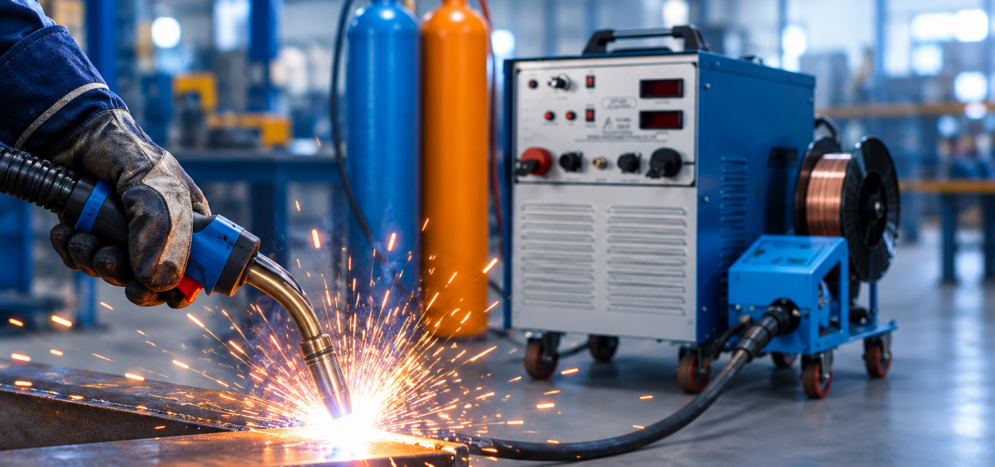
Choosing the right welding machinery is vital for effective metalworking. Having a reputable MIG/MAG Welding machine is critical for speed, strength, and versatility. It suits many industrial applications. Modern metal bonding also needs efficiency and accuracy.
The right setup helps weld different materials. It works well on thin sheet metals and heavy steel structures. It also produces strong joints and reduces spatter. This makes production more efficient.
What Is MIG/MAG Welding?
MIG and MAG are both gas-shielded arc welding processes. Both of these methods use a continuously fed wire electrode through a welding torch. An electric arc forms between the wire and the metal, generating heat to fuse the metals.
It is necessary to understand the equipment setup:
- MIG/MAG refers to the specific technique and gas combination.
- The MIG/MAG welding machine supplies the energy and feeds the wire for this process.
- A single versatile MAG welding machine can do both processes by changing the shielding gas supply.
- Understanding the MIG MAG welding process helps welders select the right parameters for successful welding.
MIG vs MAG Welding: What Is the Difference?
The only difference between MIG and MAG welding is the kind of shielding gas used. The shielding gas protects the weld pool and determines the welding characteristics.
| Feature | MIG Welding | MAG Welding |
| Full form | Metal Inert Gas | Metal Active Gas |
| Shielding gas | Inert gas | Active gas or gas mixture |
| Common gases | Argon and helium | Carbon dioxide and argon-based active mixtures |
| Common materials | Aluminium and other suitable non-ferrous metals | Carbon steel and many low-alloy steels |
| Main applications | Aluminium fabrication and selected non-ferrous metal work | Steel fabrication, machinery, and structural work |
| Gas selection | Based on material and welding requirements | Based on material, wire, and required weld characteristics |
- MIG Welding
The MIG welding machine uses an inert shielding gas. Argon gas is often used when welding aluminum. Gas Mixtures or helium may also be used for certain purposes.
The inert gas is not very reactive with the weld pool under normal welding conditions. This process is ideal for many non-ferrous metals. The right gas and wire will depend on the material being welded.
- MAG Welding
MAG welding machines use active shielding gases. These gases may include carbon dioxide or argon mixed with carbon dioxide or oxygen. The appropriate decision depends on the material and welding process.
The MAG process is popular for joining carbon steel and various low-alloy steels. Gas choice affects arc behavior, metal transfer, spatter, and weld appearance. The operator must use the recommended gas and wire specifications.
Which Process Should You Choose?
The actual difference between MIG and MAG welding depends on the materials, gas, and welding results that are expected. MIG welding can be used in aluminum and other compatible non-ferrous metals. MAG welding is frequently used in steel manufacturing.
MIG/MAG welding must always match the base metal, filler wire, shielding gas, and joint configuration. Improper consumable selection affects weld quality and increases rework.
How Does a MIG/MAG Welding Machine Work?
The MIG/MAG Welding technique is based on a simple operating concept:
- Wire Feeding: The wire-feeding machine continuously feeds solid wire through the cable assembly to the torch nozzle.
- Arc Ignition: Once the trigger is pulled, the electric circuit is closed and forms an arc of electricity between the wire tip and the workpiece.
- Melting & Joining: The heat energy melts the continuous wire and base metal, forming a puddle of liquid metal.
- Gas Protection: The shielding gas is released from the gas nozzle. It prevents atmospheric oxygen and hydrogen from entering the weld pool.
- Parameter Control: Modern power sources regulate wire speed, voltage, and current to ensure a stable arc.
When Should You Choose MIG or MAG?
Deciding whether to use a MIG welding machine or a MAG welding machine is based on the conditions at the jobsite:
- Material Type: Use MIG for non-ferrous materials and use MAG for carbon steels and structural steel.
- Material Thickness: MAG offers great penetration for thick steel plates.
- Weld Quality: Code-critical welds may require precise argon gas mixtures.
- Production Speed: The MAG process, with CO$_2$ or mixed gases, provides high speed with low-cost gases.
- Working Conditions: Indoor shops are ideal for gas shielding. In windy areas, wind shields are needed to protect the gas shielding process.
MIG MAG welding applications
MIG/MAG welding is used across several industries. This type of welding can be used on different metal parts, provided the equipment and welding parameters suit the task.
Major Industrial Uses:
- Metal Fabrication: Steel shops use continuous MIG/MAG welding setups for frame construction and custom enclosures.
- Automotive Industry: Automobile chassis, body panels, and exhaust systems rely heavily on MIG/MAG welding, both automated and semi-automated.
- Structural Engineering: Large steel beams, bridges, truss work, and civil engineering projects require MAG welding for deep root penetration.
- Sheet-Metal Fabrication: Precise control eliminates burn-through in thin metal sheets.
- Machinery Manufacturing: Farm machinery, cranes, and heavy earthmoving machines are built using strong industrial units.
What to Consider When Choosing a MIG/MAG Welding Machine?
Choosing the right equipment involves matching equipment specifications with production requirements:
- Current and Duty Cycle: Make sure the power source can handle the amperage you use daily.
- Wire Feeder System: Search for a reliable two- or four-roll drive system for wire feeding.
- Material Range: Check whether your material of interest needs DC or pulsed outputs.
- Gas Control: Inspect the quality of the solenoid valve and flow meter installation.
- Operation Mode: Select either manual, semi-automatic, or fully automatic robotic interface units.
Analyzing these aspects will help you select a durable MIG/MAG welding machine.
Conclusion
Using the right mig mag welding machine improves performance and weld quality. Understanding MIG vs MAG welding helps fabricators choose the right gases and reduce costs.
At Technocrats Plasma, we provide you with efficient industrial welding and cutting services. With years of engineering experience, we provide reliable machinery that is made to withstand tough duty cycles and constant shop operation.
Our products include inverters as well as industrial-sized equipment, depending on the type of fabrication that is being done in today’s industries. Contact Technocrats Plasma today to find the perfect welding machine for your needs.
FAQ
Q1: Can I use the same machine for both MIG and MAG welding?
Yes. A modern MIG/MAG welding machine works for both processes. You only need to change the gas canister, wire spool, and drive rollers to match the metal you’re welding.
Q2: Is MAG welding stronger than MIG welding?
The strength depends on the base metal and filler wire. However, MAG welding uses active gas mixes, which enhance heat penetration. This makes it ideal for welding heavy carbon steel joints.
Q3: What gas is best for general steel welding?
An active gas mixture of 80% Argon and 20% CO2 is commonly used in MAG welding. It gives good arc stability, deep penetration, and minimal spatter on mild steel.