

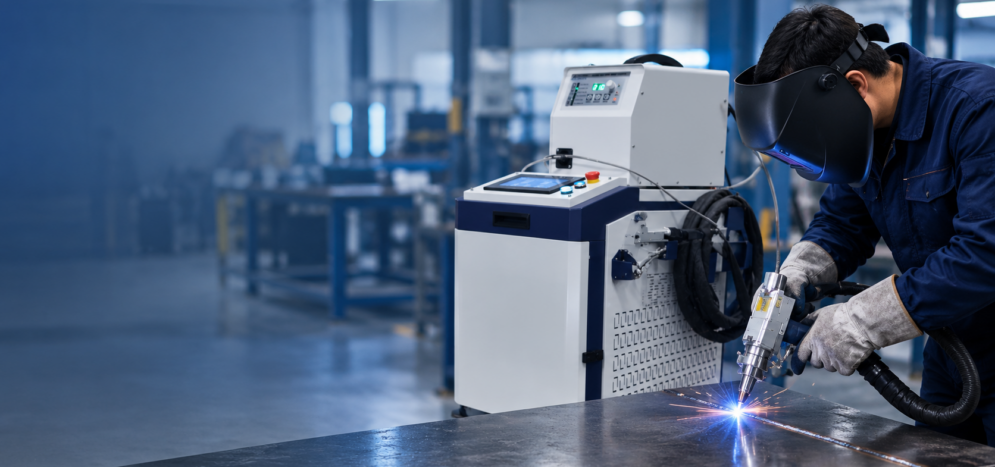
A laser welding machine joins metals with a focused laser beam. It offers accuracy and precise heat energy. This technology is used by many industries for detailed parts and repetitive production processes. It can help increase speed and minimize material distortion.
However, the best option depends on the metal type, thickness, joint, and production requirements. Understanding how it works, along with its advantages and disadvantages, helps businesses choose the right welding machines.
What Is a Laser Welding Machine?
A laser welding machine joins metal parts using a laser beam. Heat is generated by the laser beam that melts the metal to form a strong bond. Key components include the laser source, welding head, focusing lens, control system, and cooling system.
Others also include wire feeders and automated controls. The machine setup will depend on the materials and joints being used. Hand-held systems suit some fabrication operations, while automated systems suit mass production. Compare laser welding machine specifications before buying.
How Does Laser Welding Work?
Laser welding involves a well-controlled process. Each stage affects weld quality.
- Component preparation: Clean metal surfaces. Remove any unwanted matter, such as dirt, oil, and other contaminants.
- Joint alignment: Place parts in the correct positions. Joint gap should be maintained.
- Laser beam focusing: Point the laser beam at the joint. The beam’s concentrated energy generates heat.
- Material melting: The heat generated melts the metals at the joint, and the melted material forms the weld.
- Controlled movement: Move the welding head or component in the desired path. Set proper process parameters.
- Cooling and inspection: Let the weld cool before inspecting its appearance and quality against application specifications.
Laser power, welding speed, focusing position, and material properties influence the result.
Advantages of Laser Welding
Evaluate the pros and cons of laser welding based on real production needs. The major strengths of laser welding include accuracy, speed, and heat control.
- High Welding Precision
A precise laser beam will create narrow welds. This is especially beneficial when welding small parts. It is also useful for parts that require precise weld positioning.
- Faster Processing
High travel speeds can be achieved using laser welding in appropriate cases. Welding efficiency depends on metal thickness, joint type, laser power, and the required weld quality.
- Reduced Heat Distortion
The heating source is concentrated, limiting the surrounding material’s exposure to heat. This will help prevent warping and distortion. This process suits thin sheets and precise components.
- Clean and Consistent Welds
Proper machine settings can create even welds with little spatter. This may reduce the need for grinding and other finishing procedures.
- Support for Automation
Laser Welding Systems can be used with robotic arms and automated assembly lines. This will ensure consistent welds and a reliable manufacturing process.
- Suitable for Detailed Components
The narrow beam can be useful in welding complicated components. However, you must verify compatibility and joint access before selecting the equipment.
Limitations of Laser Welding
Although laser welding offers many advantages, it may not be ideal for all jobs. Some considerations are:
- Higher initial cost: It may cost more upfront than traditional welding machines.
- Accurate alignment: Inaccurate joint alignment affects welding quality.
- Material restrictions: The material used may affect welding quality.
- Thickness requirements: Thicker materials will require more power or even passes.
- Operator training: Training is essential to set up and use the tool.
- Safety requirements: The proper enclosures must be used.
Laser welding advantages and disadvantages need to be compared to those of MIG, TIG, and resistance welding. Select the method according to the material, cost, joint design, and production needs.
Where Does Laser Welding Work Best?
Laser welding is best for parts that require precision joints, tight heat control, or consistent manufacturing processes.
| Industry | Typical applications | Main requirement |
| Automotive | Metal housings, brackets, and selected body components | Consistent joints |
| Metal fabrication | Sheet metal parts and enclosures | Precision and reduced distortion |
| Precision engineering | Small metal components and assemblies | Accurate weld placement |
| Industrial equipment | Housings, fittings, and machine parts | Repeatable weld quality |
| Electronics manufacturing | Selected metal contacts and enclosures | Controlled heat input |
| Medical equipment manufacturing | Suitable metal instruments and components | Clean, controlled joints |
Laser welding applications & advantages are based on the design, material & quality standards of parts. Not all parts in these sectors need to be welded using lasers.
What to Consider Before Choosing a Laser Welding Machine?
Before buying a laser welding machine, consider the points below:
- Material type: Determine whether the materials consist of stainless steel, carbon steel, aluminum, or other metals.
- Material thickness: Check the welding depth and the machine’s capacity.
- Weld quality: Specify the joint strength, visual appearance, and quality inspection requirements.
- Production volume: Estimate daily volume and operating time.
- Joint design: Inspect component geometry, joint gaps, and welding accessibility.
- Laser power: Select power based on material type, thickness, and welding speed.
- Automation: Determine if manual operation, robot welding, or integration into a production line is appropriate.
- Operating costs: Consider electricity, maintenance, consumables, training, and safety equipment.
Request sample welds or application testing from suppliers whenever feasible. This helps determine whether the suggested setup matches your needs.
Conclusion
This type of welding machine is ideal where precision, controlled heat input, and consistency are required. It also speeds up processing and production. But never ignore equipment cost, joint preparation, material quality, or safety.
Reviewing laser welding applications and current systems can help companies choose the right process. Contact experienced laser welding machine manufacturers in India for more information on machine specifications and testing. Contact Technocrats Plasma today
FAQ
Q1. What materials can a laser welding machine join?
Laser welding machines are used to weld stainless steel, carbon steel, aluminum, and many other metals. Compatibility depends on material thickness, surface characteristics, and machine specifications.
Q2. Is laser welding better than MIG or TIG welding?
Lasers provide fast and accurate welding. MIG and TIG welding can work for other materials and joint configurations. It all depends on the production needs.
Q3. How do I choose a laser welding machine manufacturer in India?
Compare machine specifications, laser power, service, training, warranty, and spare parts. Contact laser welding machine suppliers in India for samples and application tests.